
Ouachita Parish Criminal Docket Searches
District criminal cases in Ouachita Parish live with the clerk. The Ouachita Parish Clerk of Court holds Fourth Judicial District Court filings and case-register records. The fastest way in is the clerk's current-records route to Clerk Connect Criminal Inquiry. One catch: the service runs on a subscription and login. It is not a free statewide case search. No account? The clerk counter can still pull a district-court register or filed records for you. Gather your details before you ask. Keep the year and parish coding intact in a case number. Without a number, bring the caption or party role. Add a rough filing period, the division if known, and the hearing date. Tell the clerk whether you want the register itself. Or ask for a specific charging instrument, minute entry, judgment, or motion.
- Confirm that the matter belongs in Fourth Judicial District Court rather than a city court.
- Use Clerk Connect Criminal Inquiry when an account is available, or contact the clerk about a case-register search.
- Use the public 4JDC schedules when the immediate question is the next criminal setting.
- Match the case number, division, and date before relying on an entry.
- Ask the clerk for the particular public document or certified copy needed after locating the case.
Ouachita Criminal Inquiry and Dockets
Two tools, two jobs. Criminal Inquiry handles case-level questions. A public weekly PDF or duty schedule tells you when something is set. On the public criminal side, the search options cover search type and year. They also take case type, case number, ticket number, date range, attorney, date of birth, name, and wildcard search. Live results sit behind the account gate. The labels alone don't prove every mode works without logging in. Clerk Connect's criminal search component shows the interface and its inquiry controls.
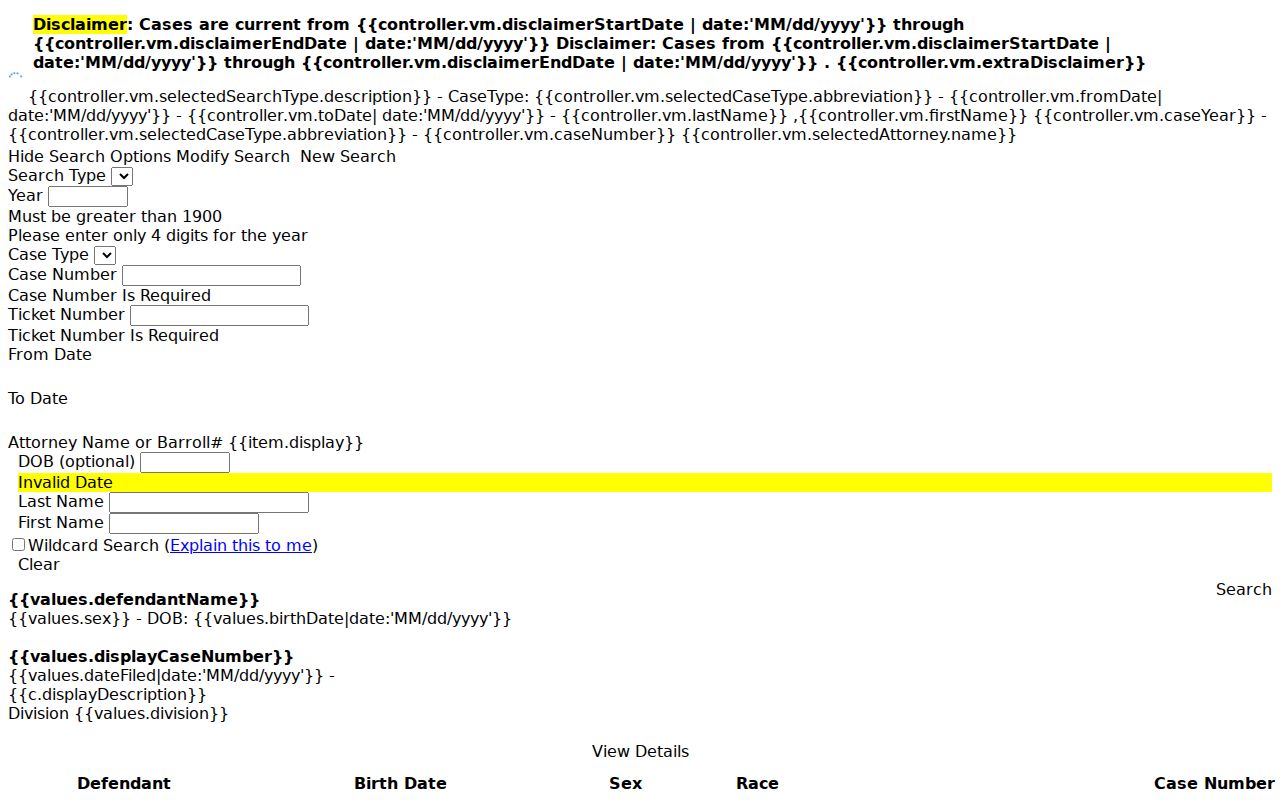
Those controls help you frame a request. For an upcoming setting, though, the weekly calendar is the more direct public tool.
Criminal Dockets: What They Show
What does a calendar line actually give you? An Ouachita criminal calendar usually lists the date, day, time, case number, case style, matter label, courtroom, and judge or division. Case numbers follow year and parish-coded patterns like 22-.... A setting might be labeled arraignment-style, hearing, bench, or trial-style. But the calendar is not a full register. It leaves out charges, bond, financial details, and documents.
| Calendar date and time | The scheduled event, not proof of a later outcome. |
|---|---|
| Case number | A court identifier that may use a year and local parish or program coding. |
| Caption and division | The displayed case style plus the assigned judge, division, and courtroom. |
| Setting label | Terms such as arraignment, bench, trial, motion, or duty describe the event being scheduled. |
| Register and documents | Ask the clerk for public charge, plea, bond, motion, continuance, judgment, appeal, or document information not shown in the PDF. |
A setting on a docket is never a conviction. Outcomes arrive later, as register or filed-document events: a judgment, plea, dismissal, or conviction.
Ouachita Criminal Docket Setting Fields
Weekly material finds the courtroom and the event, nothing more. No linked document images and no full reset history. No bond amount, charge statute, financial balance, or redaction status. When histories conflict, a later weekly entry may show a new setting. The clerk's register or signed order controls. If a criminal PDF gives only a date, ask the clerk for more: case number, filing date, charge or offense description, plea or arraignment details, bond or financial entries, motions, continuances, trial or jury settings, disposition or judgment, notice of appeal, and the exact document copies you want. Transcripts go to 4JDC Court Reporters, not the clerk. Pleadings and minutes stay with the clerk's office. The Louisiana judiciary's 2025 annual report lists 18,266 criminal filings for Ouachita and just nine criminal jury trials that year. Those numbers count events, not people or outcomes. That gap is why a single criminal calendar can brim with settings, motions, pleas, continuances, and administrative events. Court, division, case number, and event date matter most. Use them all when matching records.
Criminal Case Stages on the Docket
Criminal cases rarely move in a straight line. A filed charge may lead to arraignment, motion or pretrial settings, a plea or trial setting, and eventually a disposition. A continuance simply resets a date. A notice of appeal opens a whole new record at the Louisiana Court of Appeal, Second Circuit.
Docket flow: Charge filed › Arraignment › Pretrial settings › Plea or trial › Disposition
Read the labels plainly. Arraignment is where the charge is addressed. A plea moves forward there. "Bench" on a calendar means a non-jury trial setting. "Criminal duty" points to an assigned judge or court schedule. No label by itself tells you how the case ended.
Ouachita Criminal DWI Court Calendar
The Adult Drug & Alcohol Court is a named Fourth Judicial District Court program. It is sometimes called a DWI calendar. The court's weekly material places the specialty setting at Green Oaks, usually Thursday morning. Treat it as a calendar category only. It does not replace the criminal case register, and it reveals nothing about confidential treatment. For program details, the court's Adult Drug and Alcohol Court information is the right source. A drug-court-style prefix can appear in the broader weekly file. Confirm exact coding with the clerk first. Then route your request through it.
Ouachita Parish Criminal Docket Courts
Criminal charges in Ouachita Parish land in Fourth Judicial District Court. That trial court serves both Ouachita and Morehouse Parishes. Divisions D, E, F, H, and I sit as its criminal sections. The clerk of court keeps the filing and inquiry route for the district court docket. The court also posts criminal duty and felony-arraignment schedules. When a shared page offers links for both parishes, pick the Ouachita one.
Smaller matters follow a different track. Monroe City Court runs its own Misdemeanor Criminal/Traffic Division. West Monroe City Court does too, for cases inside each city. A city charge can later move to parish prosecution. Even so, a city citation will not simply surface through the 4JDC docket route.
Ouachita Criminal Docket Requests
Several channels lead to an Ouachita Parish criminal docket. The clerk's main number is (318) 327-1444. Court administration, listed at (318) 361-2250, handles scheduling questions. Walking up to the clerk counter works well when you lack an online account. For records that already exist, the clerk's public-records form accepts emailed requests at danab@opcoc.la.gov. It also takes faxes to (318) 327-1426, or mail addressed to Dana Benson, Clerk of Court, P.O. Box 1862, Monroe, Louisiana 71201.
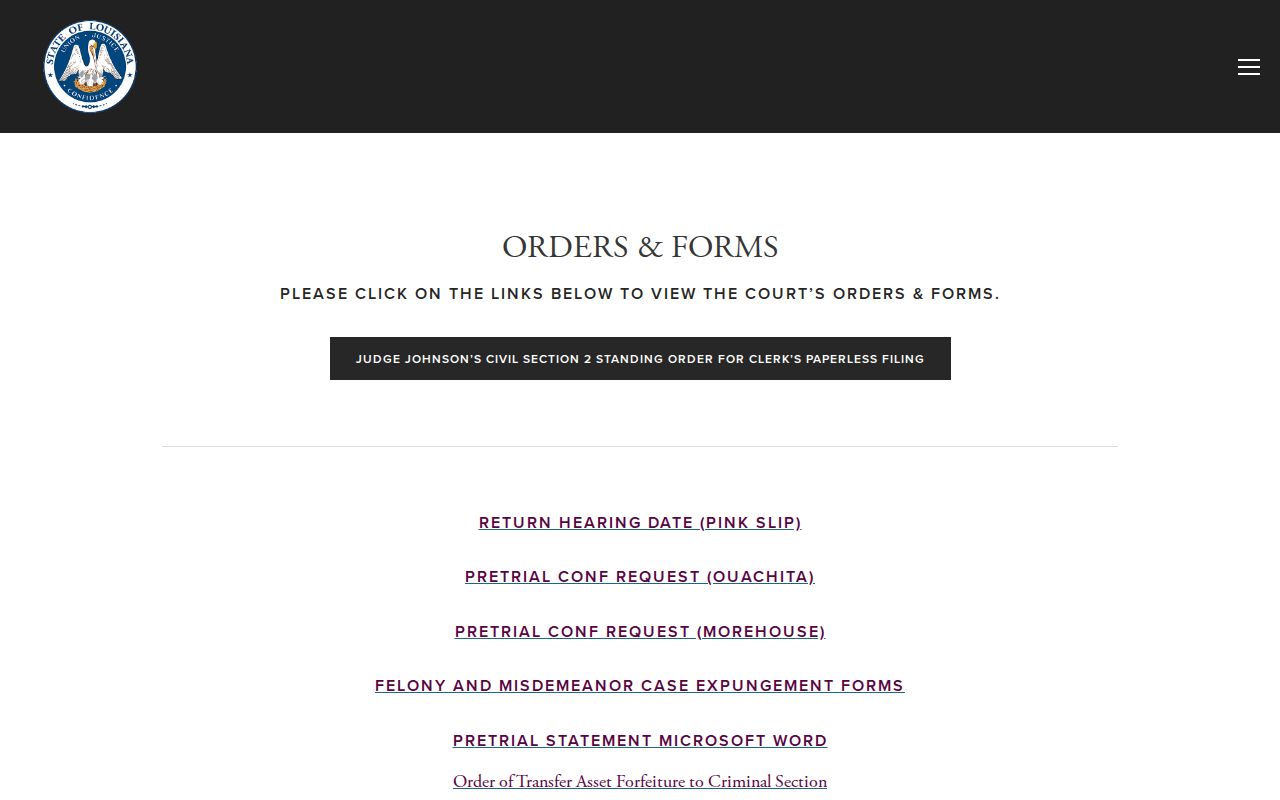
The Fourth Judicial District Court forms page posts the local expungement forms and related paperwork. That can help you sort out the right record process before you file anything.
Be specific when you ask. A request that names a case number, a date range, a register entry, or a document title gives the clerk something concrete to pull, rather than a vague hunt through the court docket.
The form lets you choose between viewing records and getting copies. Viewing during regular business hours costs nothing. Before quoting copy fees, the office gathers the responsive records, reviews them, redacts where needed, and page-numbers them. The form asks for no government ID and promises no processing time. So a tight request tied to a case number and named documents beats asking the office to build a new report from scratch.
Access Rules for Criminal Dockets
Louisiana's public-record rules back your right to inspect and copy court records. Court orders and listed exceptions still apply. A public docket still does not open every attachment to the same degree. Ask for the nonrestricted register first. Then request a defined document or a certified copy. The clerk can supply a redacted or inspection-only version where that fits.
Key Rules:
La. R.S. 44:31: establishes the right to examine and copy public records, subject to applicable exceptions.
La. C.Cr.P. art. 973: makes an expunged record confidential except for the access the statute permits.
La. R.S. 44:35: sets out a remedy path after an actual denial or the statutory period without a written determination or estimate.
Ouachita Criminal Dockets and City Courts
Where an arrest happened matters as much as what happened. Monroe and West Monroe each run their own city-court criminal and traffic channels. Neither city court offers an online case-number or name search. For a city matter, contact the city clerk or the court directly. Court Services, the district attorney, and the 4JDC schedule are other local channels for a district-court setting. None of them replaces the clerk who actually holds the file.
Juvenile cases call for restraint. The weekly material carries juvenile-style coding. Juvenile identities and captions should never be collected or republished. Expungement, meanwhile, pulls records out of public view without necessarily destroying them. The clerk's local expungement schedule lists separate charges for the clerk, state police, sheriff, district attorney, DWI processing, copies, minutes, and certification. Confirm your total against the current schedule and Articles 971, 973, and 983.