
Ouachita Parish Court Record Requests
Every Ouachita Parish court record request starts with one question. Which court holds this file? Fourth Judicial District Court matters may go through Clerk Connect. It offers account-based inquiry, printing, and document-image access. When that does not pan out, the clerk counter and a written public-records request are the fallbacks. You can request in person, call with access questions, or send the request by email, fax, or mail. Monroe and West Monroe city cases go elsewhere. Their own city-court clerks hold those records. A justice-of-the-peace record stays with the JP who issued it. A federal case runs through PACER and the federal court process.
Ask for a record that exists, not a new report. Name the court and the case number. Give the date range and the record type too. Add the exact document if you know it. Say whether you want to view or copy, and whether you need certification. The Ouachita form allows attachments. It makes you choose between viewing and copying. It sets no identification requirement and makes no processing-time promise.
- Identify the issuing court and retain the case number, caption, or a hearing date.
- Choose Clerk Connect for account-based Fourth JDC inquiry, or use the clerk/court counter when the online path does not show the needed record.
- For a broader existing-record request, complete the Ouachita public-records request form with a detailed description and view/copy choice.
- Submit the form by email to danab@opcoc.la.gov, fax it to (318) 327-1426, or mail it to Dana Benson, P.O. Box 1862, Monroe, LA 71201.
- Wait for the clerk's review, any redaction and page count, then select the offered reproduction option or request certification when it is required.
Ouachita Clerk Request Channels
The request form draws a clear line between inspection and copying. Once records are ready to view, the office notifies the requester. Viewing during regular business hours costs nothing. Copying works differently. The office first collects, reviews, redacts where needed, and page-numbers the material. It then offers physical or electronic reproduction options with the costs. That sequence matters because the page count is often unknown at the start.
Clerk Connect gives another route. Its online page-printing rate and account access do not replace the request form. For a Fourth JDC access question, the clerk lists (318) 327-1444, extension 3501. A call can sort out the right records channel fast. Still, the written form serves best. Use it when you need a date range, a document title, or a written view-or-copy choice on record.
Useful request wording: Name the court first, then the case number, date range, record or document title, view/copy choice, and any need for a certified copy.
Kinds of Court Records
"Court record" covers several distinct layers, and the word you use shapes what you get. The Fourth JDC weekly PDF is just a calendar of settings. A docket or register lists filed events in order. The case file holds the documents behind those events. Request the narrowest item you need. A calendar line will never match a signed judgment, a minute entry, or a transcript.
For Ouachita Parish district-court filings and certifications, the clerk's record process is the source. Monroe City Court names its clerk office as repository. It holds files, dockets, and journals. West Monroe splits its clerk lines between civil and criminal/traffic work. Federal documents sit entirely apart from parish and city files.
- Weekly calendar or setting information
- Docket or register entries recording events by date
- Pleadings such as petitions, answers, motions, and rules
- Orders, judgments, minute entries, exhibits, and certified copies
- Transcripts ordered separately through court reporters
Ouachita Docket and Case File Difference
A public calendar tells you when a matter is set. Nothing more. A docket or register records what was entered and when. The filed record is the document itself. That could be a petition, order, judgment, exhibit, or transcript. The dated 4JDC PDF is handy. It can give you a courtroom, a date, a division, or a setting label. It will not show every financial entry, document attachment, disposition, appeal link, or redaction status.
When you need a filed document, name its title. Then request it from the clerk or through the authorized online route. A printout from an inquiry service is not automatically a certified copy. That gap matters. It appears when a court, an agency, or a later filing demands clerk-certified proof of a particular judgment or order.
| Record layer | Main question answered | Ouachita source or route |
|---|---|---|
| Calendar or setting | When and where is the event scheduled? | 4JDC dated weekly PDF or schedule page, then court confirmation. |
| Docket or register | What event was entered, and when? | Clerk Connect where available, or clerk/court inquiry. |
| Filed document | What did the filing, order, or judgment say? | Clerk request, account-based document route, or issuing court. |
| Certified copy | What is the clerk-certified version of a specific record? | Ask the custodian for certification of the identified document. |
Court Records: What They Contain
What a record contains depends on its layer and on access rules. A case number, caption, division, filing date, setting date, and event label all help you locate a file. The filed materials behind it can include initiating papers, responses, motions, orders, judgments, exhibits, and related minute entries. The weekly calendar is no substitute for those materials. The same case number on it changes nothing.
Some fields may not appear in a public view because the calendar may lack them. The service may be account-gated, or the field may be restricted or redacted. A disposition is an outcome entry: a judgment, plea, conviction, dismissal, or other court action. A setting is only the scheduled event. Never read one as the other.
| Case number | The court-assigned identifier used to find the correct case file or register. |
|---|---|
| Pleadings | Filed papers such as a petition, answer, motion, rule, or other request for court action. |
| Orders and judgments | Signed court rulings or entered decisions. Request the specific document when proof is needed. |
| Docket or register | The chronological case-event record, which is different from the weekly setting calendar. |
| Exhibits and transcripts | Materials that may have separate access limits or separate ordering channels. |
Ouachita Court Reporter Transcripts
A hearing transcript does not come from the weekly docket PDF. Fourth JDC sends transcript orders to its Court Reporters office. It is separate from the ordinary clerk request. The office sits in Room 301. Its phone is (318) 361-2261 and its fax is (318) 329-1283. No published transcript fee exists. Ask the reporter office for the amount. The Fourth JDC Court Reporters office page lays out this separate transcript route for Ouachita court records.
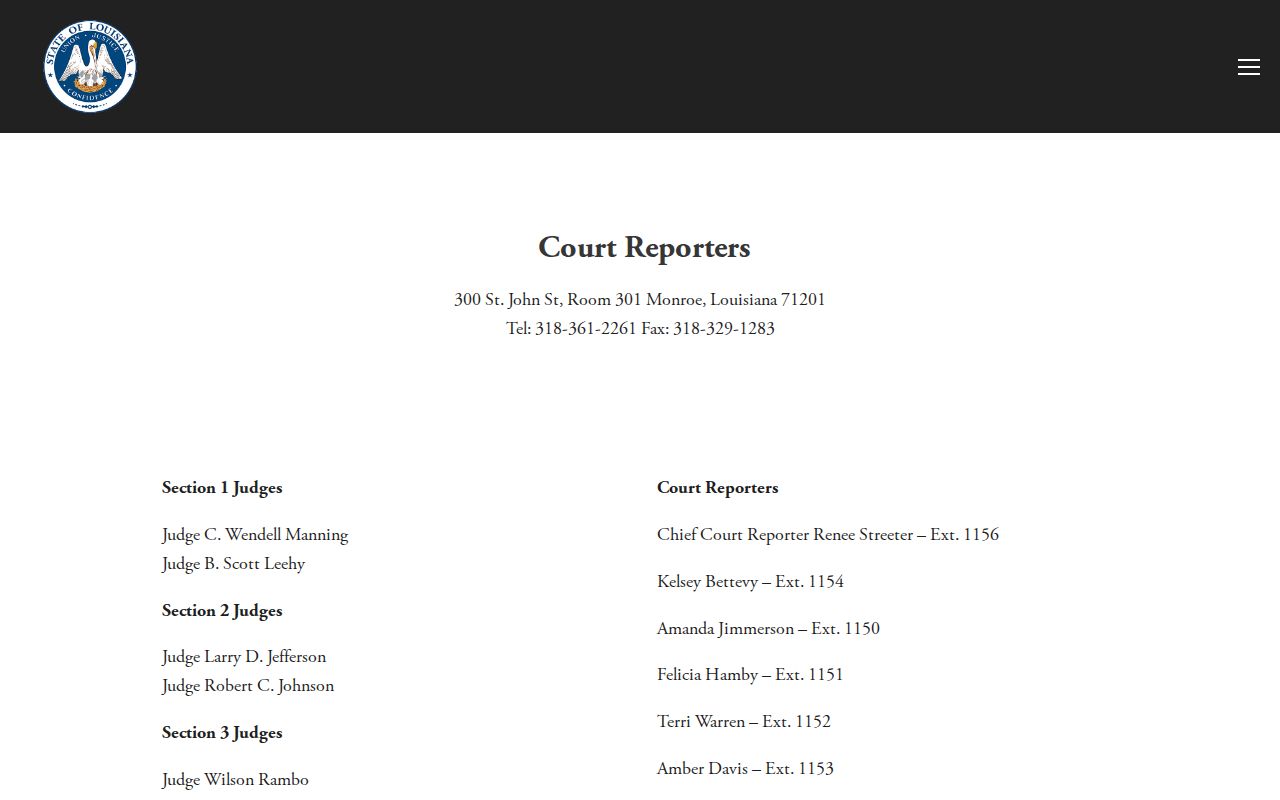
The Court Reporters listing confirms the split. An official transcript request follows its own channel, apart from a clerk copy or a calendar lookup.
Copy Fees and Certification
Copies come in several grades. The price climbs with each one. A plain copy just reproduces the page. A conformed copy adds a clerk confirmation on top of the copy charge. Certified copies cost the most. You pay the clerk's certification fee plus the per-page charge. So before you order, figure out what the receiving court or agency actually needs. Name the exact judgment, order, or document, and ask whether certification is required. An online printout will not always do the job.
The clerk also treats certificates and court minutes as separate products with their own fees. Card transactions, where stated, add a 3.49% convenience fee with a $1 minimum. None of these charges swap for one another. The public-records form lets the clerk quote copy costs after review and page numbering. The official Ouachita copy-fee data breaks out each court-record option the clerk offers.
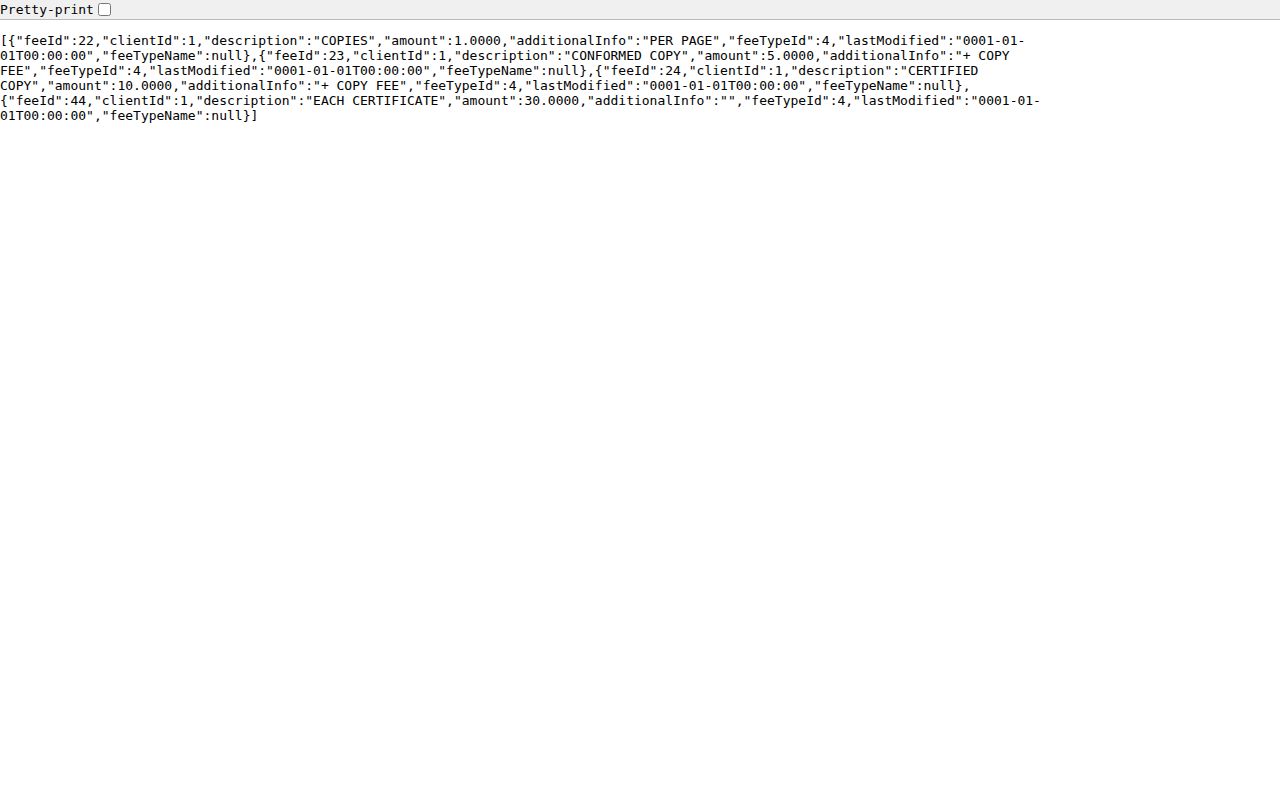
The fee display separates a basic page copy from conformed, certified, certificate, and minute requests.
| Item | Amount | Use |
|---|---|---|
| Plain copy | $1 per page | Basic reproduction of requested pages. |
| Conformed copy | $5 plus copy fee | Copy with the separate conformed charge. |
| Certified copy | $10 plus copy fee | Clerk-certified reproduction of the identified record. |
| Certificate | $30 | A distinct certificate product. |
| Court minutes | $10 per date | Request by the relevant court date. |
Ouachita Parish Clerk of Court
Public-records and Fourth JDC access questions
P.O. Box 1862, Monroe, LA 71201
(318) 327-1444, extension 3501
Ouachita Clerk Connect Printing
Clerk Connect charges $0.50 per page for online printing through its account-based service. That rate buys convenience, not authority. A certified copy from the Ouachita clerk runs a $10 certification charge plus the per-page copy fee. That is a different product for a different purpose. A portal printout helps you find and read an available court record. It does not automatically satisfy an official filing or proof request.
Access plans come as a day pass, a month, or a year subscription, and document images may sit behind an added gate. Before paying for certified paper, ask two questions. Is an electronic copy available? Does the recipient truly require certification? Those answers can save you from ordering a more formal record than the job needs.
| Route | What it provides | What it does not establish |
|---|---|---|
| Clerk Connect print | An available online page through the account service. | Automatic clerk certification. |
| Plain clerk copy | Requested page reproduction. | Certification or a separate certificate. |
| Certified clerk copy | Certified reproduction of the identified record. | Access to a different restricted document. |
Access Rules for Court Records
Louisiana public-record law grants inspection and copying rights for records that already exist. Set exceptions still apply. A custodian can redact, withhold, or limit material. The basis may be a court order, a sealing rule, a confidentiality rule, or private-data protection. Sealed, expunged, juvenile, protective-order, and certain family materials call for extra care. Keep one thing in mind. A public docket does not make every attachment public in the same form.
Start with the non-restricted register when it will identify the document you need. If access is denied, ask for the legal basis. Ask whether a redacted copy exists, and whether inspection-only viewing is possible. Denial triggers a statutory remedy. The same remedy applies after no timely written determination. That is not a promise that every request gets filled within a fixed period.
Key rules: La. R.S. 44:1 defines public records and custodians. La. R.S. 44:31 establishes the right to examine and copy records subject to exceptions. La. R.S. 44:32 addresses procedures and reasonable copy fees, while La. R.S. 44:35 addresses remedies.
Ouachita Federal Court Records
Federal cases take a separate route entirely. The Western District of Louisiana runs on PACER and CM/ECF, not Ouachita Clerk Connect. PACER draws its own line between docket entries and document images. Pulling a document costs money under the federal fee schedule. A public terminal at the courthouse may offer free access under PACER guidance. A CourtListener or RECAP copy, when one exists, is not the official custodian's record.
Bankruptcy stays federal too. A local party does not pull the case into the parish clerk's court records. The same goes for local property. The Western District Bankruptcy Court Monroe information describes Monroe as an unmanned office. Chapter-specific support routes to Shreveport or Alexandria.
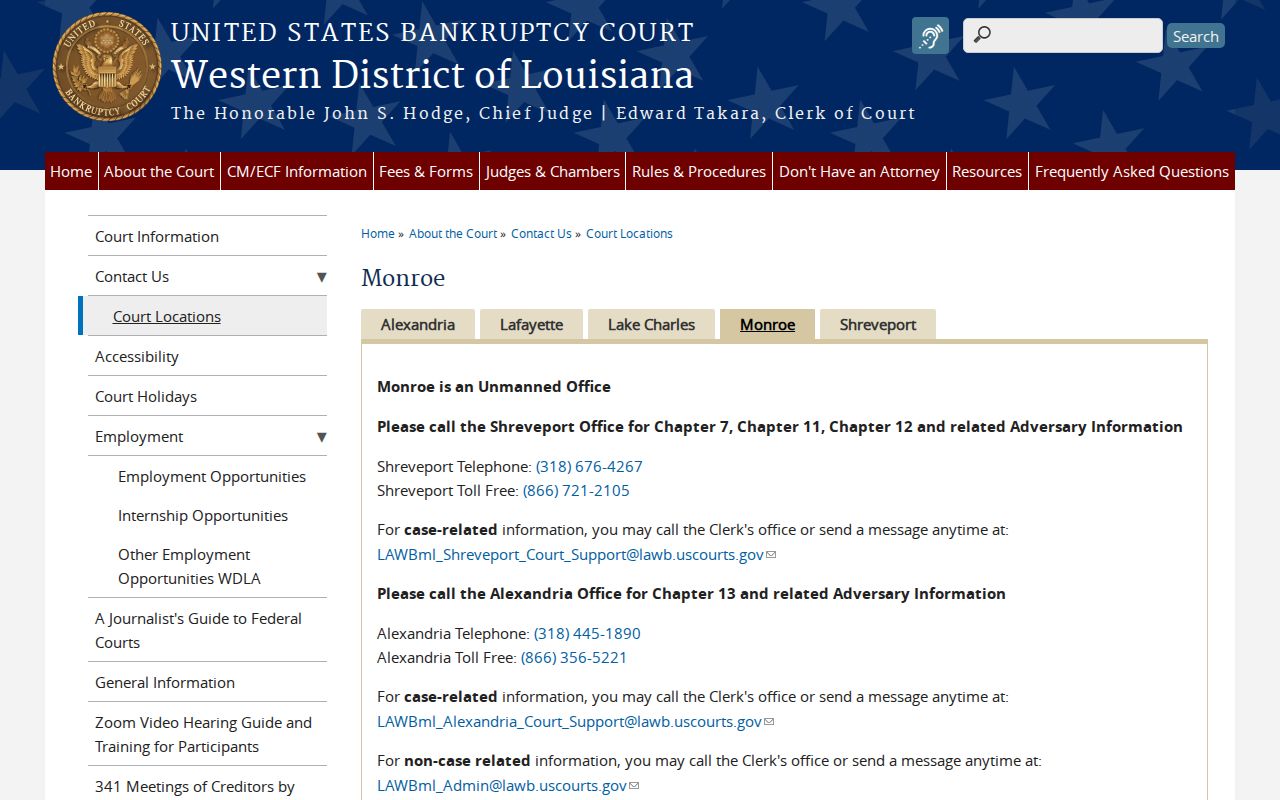
The Monroe bankruptcy office shows why federal documents must go through the federal court process rather than a parish court-record request.
Note: Request a certified state-court record from the issuing clerk, and a federal record from the federal court system that maintains it.